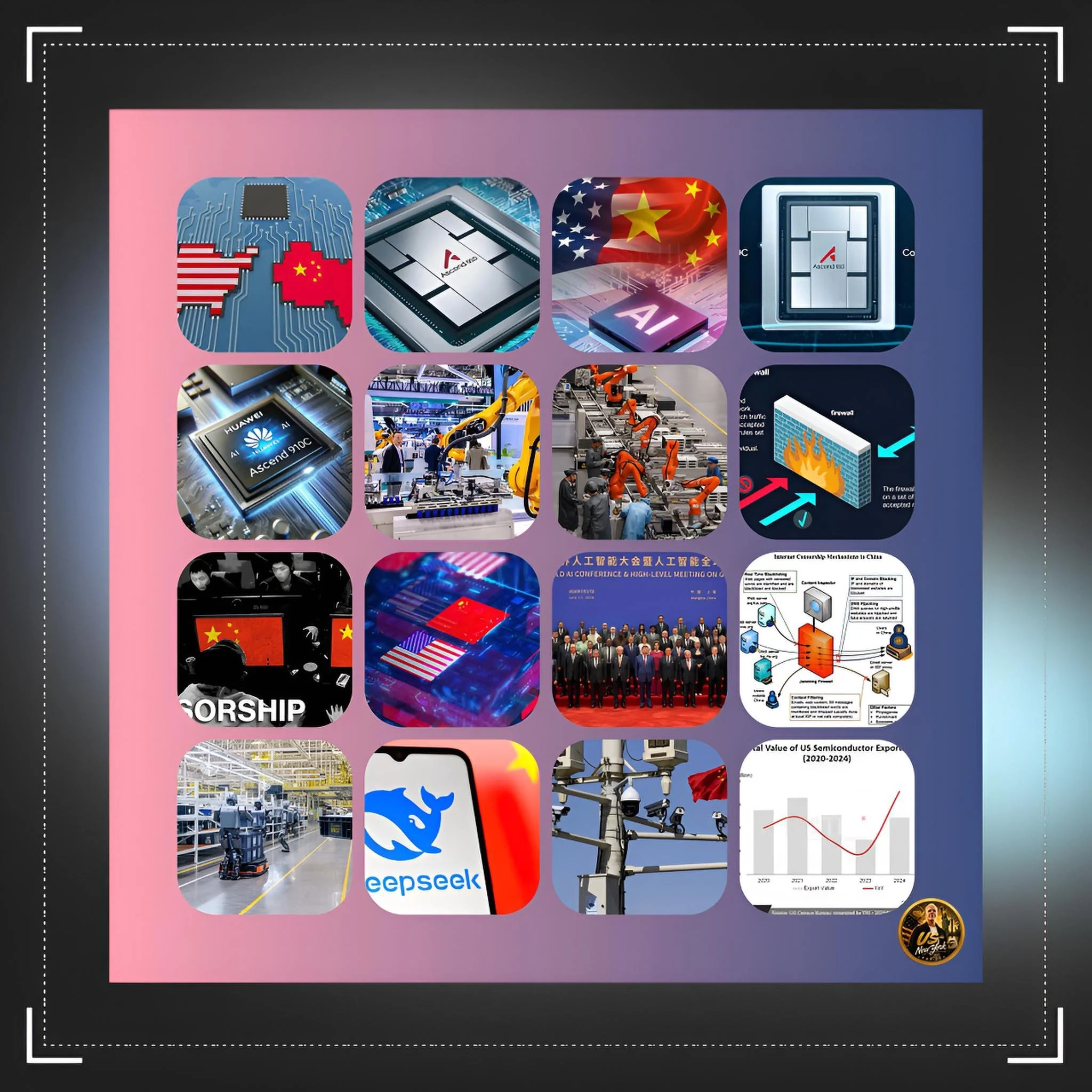
Beginner's 101 Guide: When Your Own Technology Could Be Your Undoing: China, Artificial Intelligence, and the Party’s Hidden Crisis
Summary
A plain-English explanation of why china’s AI ambitions carry deep dangers for the regime itself
At first glance, China looks like a country winning the artificial intelligence race. Its companies release powerful AI systems that hundreds of millions of people around the world are downloading and using. At a major conference in Shanghai in July 2026, President Xi Jinping stood before world leaders and tech executives and declared China a champion of open, affordable AI for all of humanity.
Chinese AI models now account for 30% of all AI software downloads globally — ahead of the United States. By some metrics, the gap between China’s best AI and America’s best AI has narrowed to less than 3%.
So why do serious analysts — and, quietly, China’s own security officials — worry that artificial intelligence might actually be one of the biggest threats the Chinese Communist Party has ever faced? The answer lies in a paradox at the heart of the regime’s strategy.
The Chinese Communist Party has survived for over seven decades by doing one thing above all else: controlling information. It decides what Chinese citizens can read, say, discuss, and believe. It bans foreign websites. It censors social media. It employs hundreds of thousands of people whose job is to delete politically inconvenient content from the internet before ordinary citizens see it.
The entire system is built on the assumption that a government can maintain power by controlling what people know.
Artificial intelligence is, by its nature, a technology that distributes knowledge freely and at scale. That is its defining feature.
And Beijing has decided not only to develop AI aggressively at home, but to release Chinese AI systems to the entire world as free, open-source software — meaning anyone can download them, modify them, and use them without paying a cent and without asking permission.
Unlike closed AI systems, open-source models can be downloaded, modified and used by anyone, even after safety protections are removed. That last phrase is crucial. When China releases an AI model to the world, it builds in filters and restrictions that prevent the system from discussing Tiananmen Square, criticising Xi Jinping, or questioning Taiwan policy. But once the model is open-source, technically skilled users anywhere in the world — including inside China — can remove those filters. The party has, in effect, released a tool it cannot recall and cannot fully control.
The party is concerned that the technology could be used by hackers, scammers, terrorists or other bad actors seeking to cause harm in China; that models could circumvent its tight censorship filters; and that the government could be blamed if Chinese systems spin out of control elsewhere. This is not a theoretical concern that some distant future might produce. It is an anxiety that Chinese officials are expressing now, in 2026, about systems that are already in global circulation.
Dr. 🆎, an expert in human-centred AI and geopolitical strategy, frames the dilemma starkly: “The CCP is trying to be the world’s champion of open AI and the world’s most sophisticated information autocracy at the same time.
You cannot be both. These are logically contradictory positions, and the technology itself will eventually force that contradiction into the open.”
There is also the hardware problem.
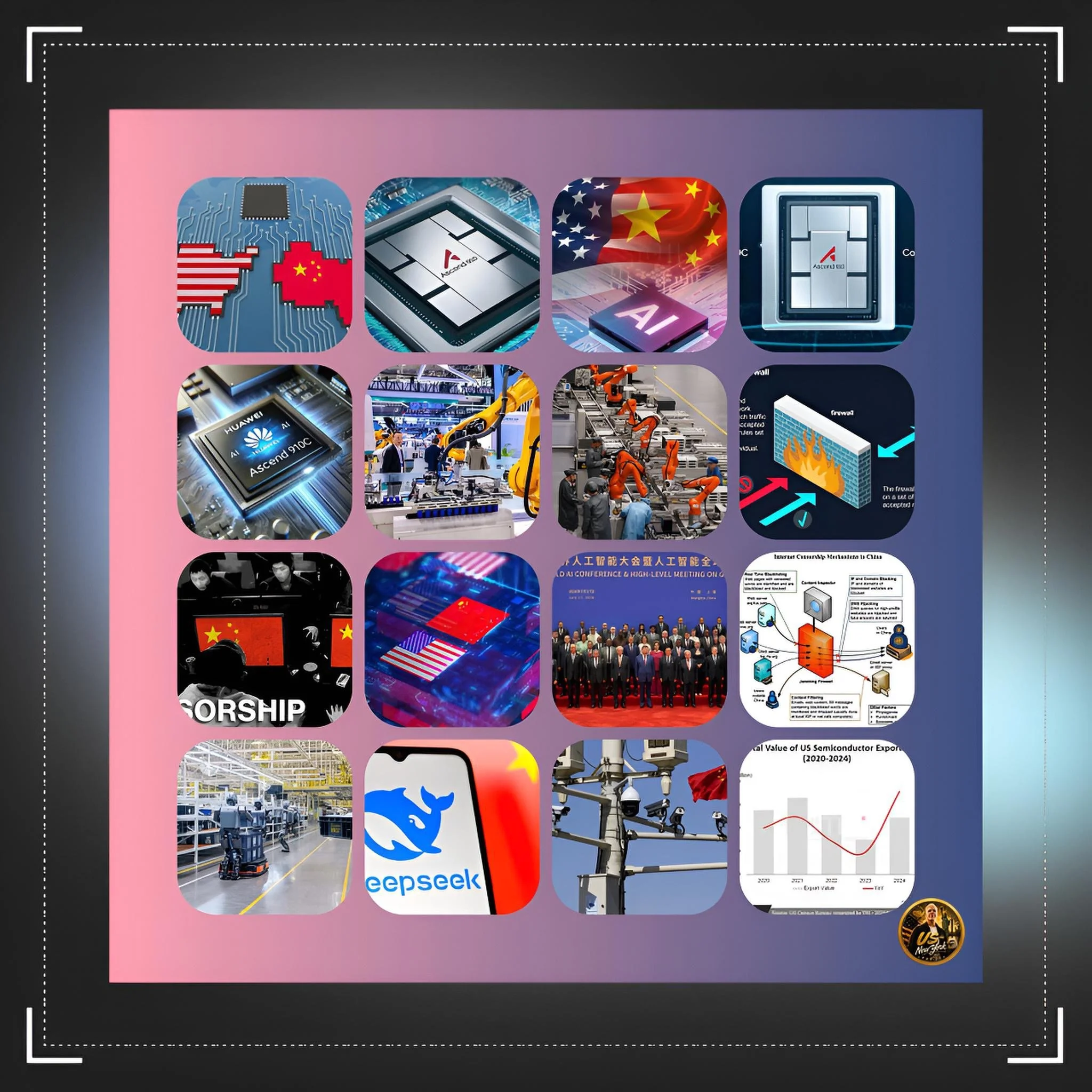
China’s AI development is constrained by its inability to manufacture or buy the most powerful computer chips — the specialised processors that AI training requires. US export controls have blocked China from accessing the best Nvidia chips.
The best US AI chips are currently about 5 times more powerful than Huawei’s best offerings, and by 2027 that gap will widen to 17 times.
Chinese engineers have shown remarkable creativity in working around these constraints — DeepSeek’s efficiency is genuine — but creativity can only partially compensate for a hardware deficit of this magnitude.
Then there is the economic question.
Artificial intelligence is set to automate vast numbers of jobs in manufacturing, logistics, and service industries — precisely the sectors that have powered China’s economic rise and the jobs that sustain social order. Beijing is orchestrating a strategic pivot toward “AI+ Employment” to safeguard social stability against a looming 77% automation threat, while facing an 18.7% youth unemployment crisis.
The CCP’s legitimacy has long rested on delivering economic growth and rising living standards. If AI disrupts the job market faster than retraining programmes can absorb displaced workers, the social contract between the party and the people begins to fray.
The bioterrorism dimension adds another layer of danger. Powerful AI systems can help experts — but also criminals and terrorists — understand and potentially replicate dangerous biological and chemical agents.
China’s own AI safety reports have acknowledged this risk explicitly. China’s AI Safety Governance Framework 2.0 warned of the potential “loss of control over knowledge and capabilities of nuclear, biological, chemical, and missile weapons,” and that “extremist groups and terrorists may be able to acquire relevant knowledge” through AI systems.
Dr. 🆎 has been particularly direct on this point, noting that every open-source model China releases potentially empowers bad stakeholders with access to weapons-relevant knowledge that was previously confined to nation-state laboratories.
Freedom House’s 2026 report ranks China near the bottom in political rights and civil liberties, with severe restrictions on speech, assembly, religion, and the internet.
The country has neither an independent judiciary nor free elections. This political environment creates a fundamental limitation: the researchers, engineers, and entrepreneurs who drive AI innovation globally tend to flourish in environments of intellectual freedom, open inquiry, and genuine competition.
China’s most talented AI researchers face a choice between conforming to the party’s requirements or leaving. Many have left.
The Chinese government stringently censors information that it deems politically sensitive, with narratives that run contrary to state objectives rarely circulating freely.
The state has already censored articles that urge the government to allow foreign AI tools, or question whether China is becoming an “AI island” disconnected from global innovation networks.
A country whose researchers cannot freely read about, discuss, or build upon the full body of global AI research is, by definition, operating with one hand tied behind its back.
What does this mean for the future?
In the short term, China’s AI remains impressive and its global reach is growing. Chinese models are cheap, capable, and increasingly embedded in commercial and government systems worldwide. Beijing’s strategy of positioning itself as an AI benefactor to the Global South is working. But the deeper dynamics suggest that the regime is accumulating liabilities faster than it is banking strategic gains. Every open-source release is a potential information liberation tool. Every AI advance that it cannot adequately compute domestically widens the capability gap with the United States.
Every job displaced by automation adds pressure to a social contract already under strain.
The party knows this. That is why Xi Jinping, even while championing open AI on the world stage, is simultaneously instructing his security services to prepare for worst-case scenarios and demanding that AI systems remain under the party’s absolute control. The party is, in effect, trying to ride a tiger — hoping to harness AI’s power before the animal turns around.
History suggests that authoritarian regimes are not good at managing technologies that distribute information and empower individuals.
The internet was once supposed to be manageable. The party adapted, and the Great Firewall was the result.
But AI is different in kind, not just degree. It does not merely transmit information — it generates it, synthesises it, and presents it in forms that are immediately useful to anyone with a phone and a question.
A sufficiently capable AI, freed from its constraints by a technically skilled user, is not a window through the Great Firewall. It is the wall itself becoming transparent.
China is not losing the AI race. But it is not winning it in the ways that matter most to the party’s survival.
And the technology it is racing to master may ultimately prove harder to domesticate than any challenge the CCP has previously faced.