America's Big Election Shake-Up: What It Means for Trade, AI and Computer Chips
Introduction
Executive Summary
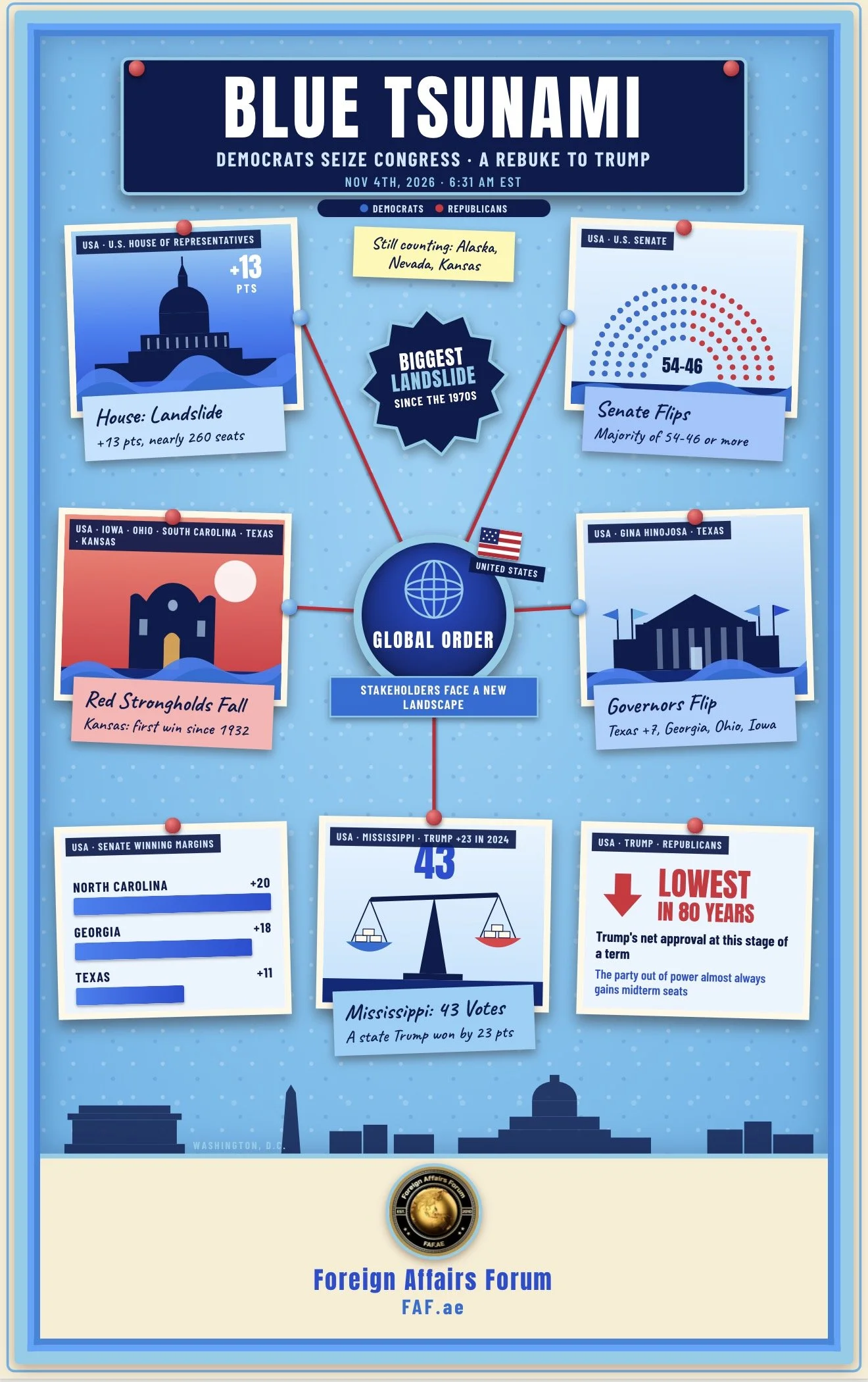
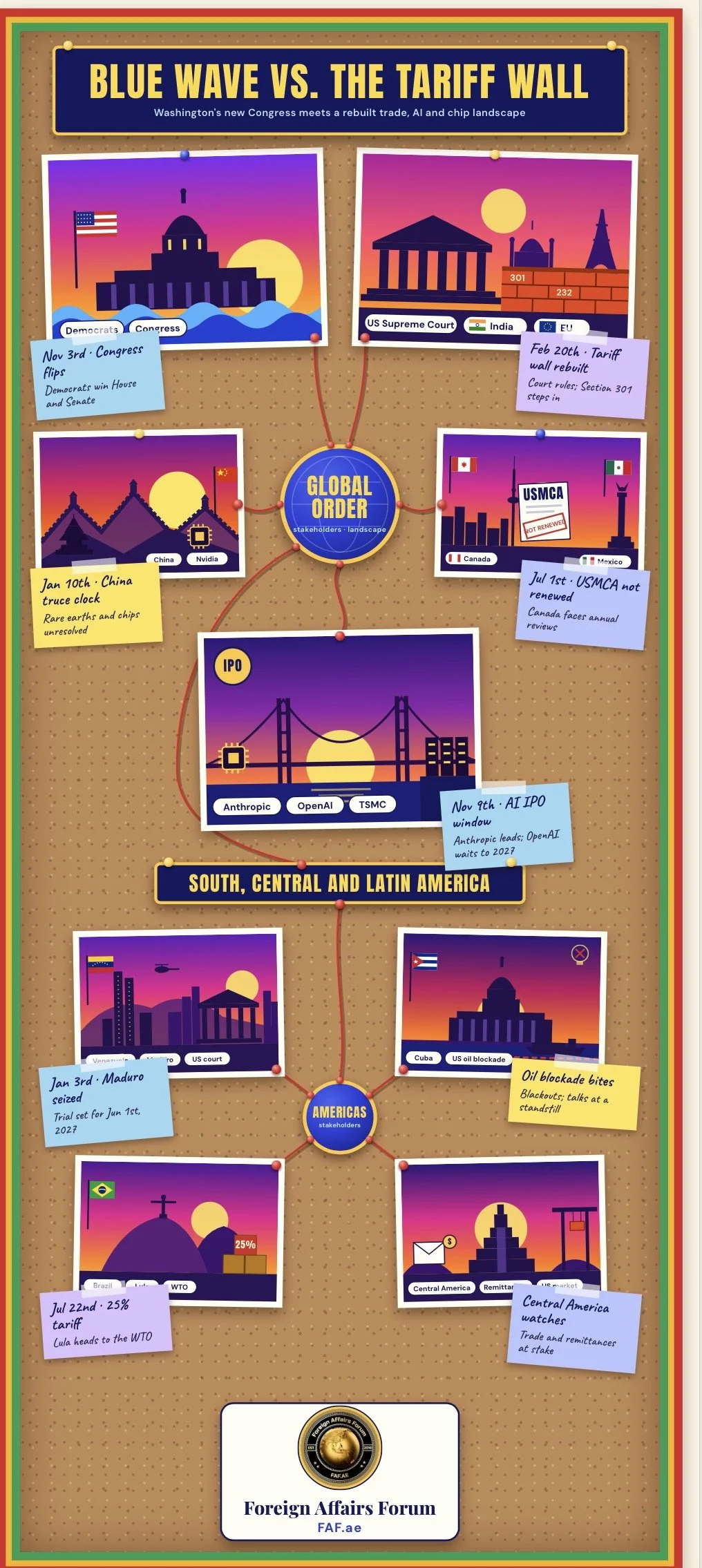
On Nov 3rd, 2026, American voters gave Democrats control of both the House of Representatives and the Senate. Early estimates suggest Democrats will hold about 245 House seats and about 53 Senate seats, although some votes are still being counted. The new Congress starts work in January 2027.
This FAF article explains what this could mean for four big topics. The first is the trade wars that the United States has fought with China, Canada, Europe and India. The second is the relationship with South, Central and Latin America, including the cases of Venezuela, Cuba and Brazil. The third is American spending on artificial intelligence and the plans of big AI companies such as OpenAI and Anthropic to sell shares to the public. The fourth is the future of computer chips, supercomputers and data centers.
The main message is simple. Winning an election does not mean a party can change everything. The president can still say no to new laws, and most of the president's tariffs now rest on legal tools that Congress cannot easily remove. So expect more arguments, more investigations and more pressure, but not a sudden end to the trade wars or to the tough policies toward Latin America.
Dr. Antonio Bhardwaj, known as Dr. 🆎, an expert on superintelligence, AI warfare and bioterrorism risk, puts it this way: a country's strength in the AI age depends on whether its leaders can stay steady and trustworthy, not only on who holds power on any given day.
Introduction
Elections in powerful countries affect the whole world. When Americans vote, businesses in Canada, farmers in India, carmakers in Germany and tech companies in Asia all watch closely. This time, Democrats flipped Senate seats in states such as Texas, Ohio, Iowa, North Carolina, South Carolina, Maine and Kansas, and they won the House as well. Many voters said they were worried about high prices, rising electricity bills and the costs linked to tariffs and to the war with Iran. The president said he would accept the result.
Dr. 🆎 believes that trade, AI and chips are not separate subjects. Tariffs change what it costs to build computer systems. Those systems decide how much money AI companies can raise. And that money decides how strong, safe and competitive a country can be. If one link breaks, the others suffer. The same is true for America's neighbours in the south, whose economies depend on decisions made in Washington.
History and Current Status
For many years, Congress allowed presidents to set some tariffs, because it expected them to use that power carefully. In 2025, the president used an emergency law to put tariffs on almost every country. Some were very high. China faced rates that reached triple digits, and India faced 50% at one point because of a dispute over Russian oil.
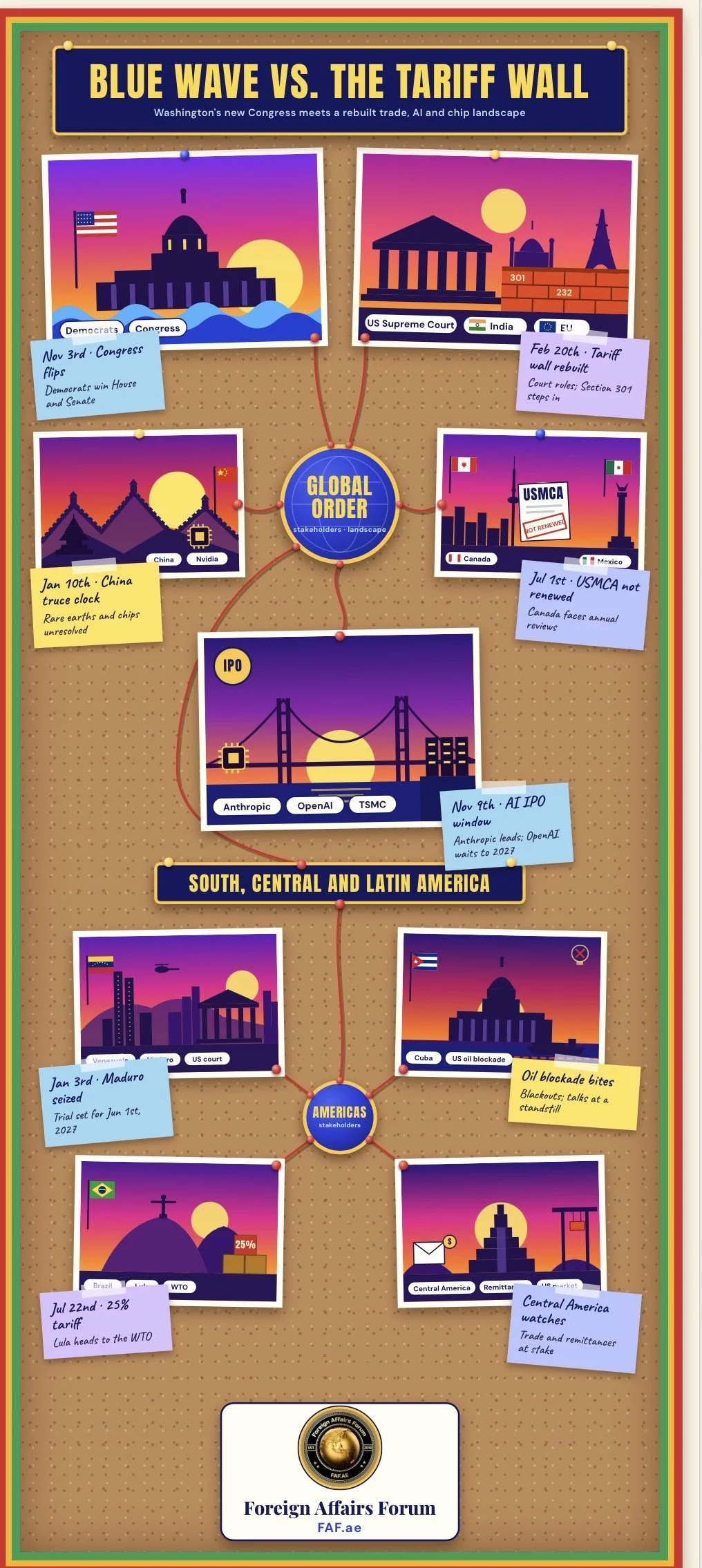
In February 2026, the Supreme Court ruled that the emergency law does not allow a president to set tariffs. That ended the old system. But the president quickly used other laws. First came a temporary 10% tariff on most imports, which lasted for the legal limit of one hundred and fifty days and ended on Jul 24th. On that same day, a new set of tariffs of 10% to 12.5% began on about sixty economies, based on a different law about unfair trade practices, which is much harder to challenge in court. Other tariffs on steel, aluminium, copper and cars continue at 25%. On average, American tariffs are now around 11%, the highest in generations.
With China, the two countries have a fragile truce. It was recently extended, but only until Jan 10th, 2027. Big questions about rare earth minerals, farm purchases and technology rules are still open.
With Canada, relations are strained. In July, the United States refused to renew the North American trade agreement in its current form, so it will now be reviewed every year. Some Canadian goods also face 50% tariffs.
With India, a deal in February cut tariffs to 18% and removed a penalty linked to Russian oil. After the court ruling, India's effective rate is about 12%, and talks on a bigger deal continue. India also signed a major trade agreement with the European Union.
With Europe, the trade understandings from 2025 are still partly in place, but they are less certain because the legal basis for American tariffs keeps changing.
In technology, America passed the CHIPS Act in 2022, offering about $52.7 billion to build chip factories at home. The government has taken a 10% stake in Intel, put a 25% tariff on some advanced chips, and changed its rules on selling top chips to China several times. Taiwan's TSMC has promised $165 billion for factories in Arizona.
In the AI business, OpenAI raised $122 billion at a value of $852 billion earlier this year. Anthropic is preparing to sell shares to the public and may start meeting investors as early as the week of Nov 9th. Reports suggest it could be valued at more than $2 trillion, which would be the biggest share sale ever. OpenAI has said its own sale will wait until 2027.
Key Developments
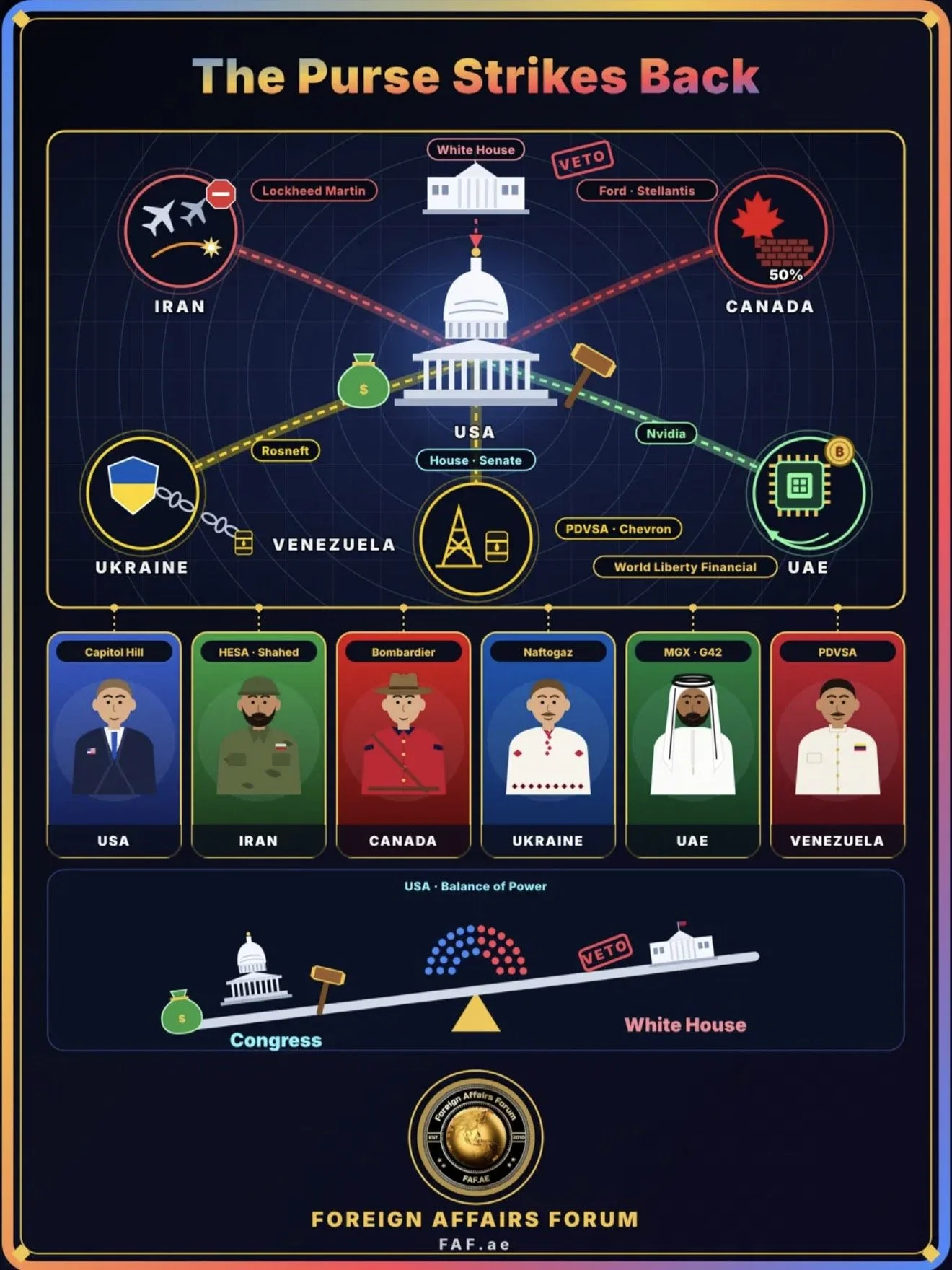
The biggest legal development is that the president's tariffs now stand on stronger ground. The tools now used cannot be cancelled by Congress without a law that survives a presidential veto, and overriding a veto needs two-thirds of both chambers. Democrats do not have that many votes.
Another key development is that tariffs became a major election issue. Surveys showed that about three quarters of voters thought tariffs were important, and Democrats argued that tariffs act like a tax on American families. Several Democratic senators have already proposed laws to take back trade powers from the president.
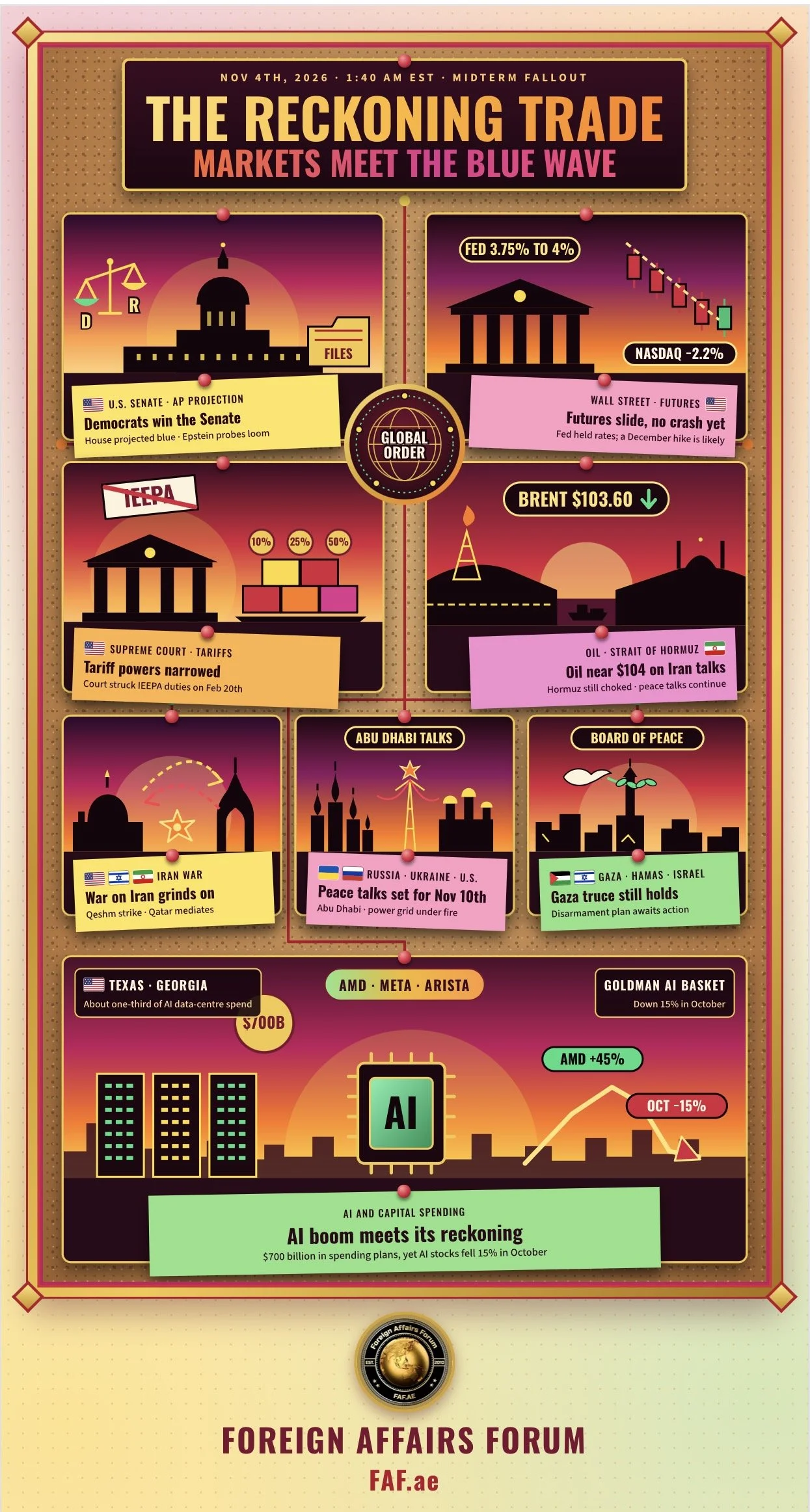
A third development is the growing public worry about data centers. These huge buildings use enormous amounts of electricity. Home electricity prices have risen by about a third in five years, and local protests stopped at least twenty-five projects last year. Democratic senators have questioned technology companies about who pays for the power. OpenAI and Anthropic have promised to cover any price rises caused by their own data centers.
A fourth development is the timing of AI share sales. Companies waited for the election to pass before going ahead, because political uncertainty can change how investors price a company.
Latest Facts and Concerns
As of today, Democrats are projected to control both chambers, but the president can still veto laws. This is the most important fact for everything that follows.
For trade, the concern is confusion. Companies face a mix of different tariffs under different laws, and refunds for the tariffs the court struck down are still being sorted out.
For Canada, the worry is that Democrats will offer sympathy but not real relief. For Europe, the worry is that agreements might change again. For India, the worry is that the larger deal is unfinished and that about 70% of Indian exports now face an extra 10% charge. For China, the worry is that the truce is short and that China controls more than 90% of the world's processed rare earth minerals, which are vital for cars, phones and weapons.
Latin America is also affected by the election. US forces captured Venezuela's former leader, Nicolás Maduro, and his wife on Jan 3rd and took them to New York. They face drug charges, and their trial is set for Jun 1st, 2027. Maduro's lawyers say he cannot be prosecuted because he led a country. Democrats in Congress cannot stop the case, but they can ask hard questions about how the raid was justified and what happens next in Venezuela. Cuba is in a deeper crisis. The US has cut off most of the island's oil, and Cuba says many families get only two or three hours of electricity a day. Cuba says the US embargo cost it $8.1 billion in 2025. Talks started in April but have stalled, and on Sep 7th Cuba said no negotiations are happening. Some Democrats want to challenge this policy, but the president still controls it.
Brazil now faces a 25% US tariff on most of its goods, in place since Jul 22nd. Beef, coffee and aircraft are exempt, and another investigation could raise the total to 37.5%. President Lula called the tariff unfair and said Brazil will answer with its own trade rules and a complaint at the World Trade Organization. Smaller countries in Central America depend on American trade and money sent home by workers, so they are watching closely.
Dr. 🆎 says the Americas are the first test of a divided Washington: other countries will see whether Congress can actually restrain the president or whether he will simply find new legal tools.
For AI, the worry is that investors may see a Democratic Congress as a risk to the industry's rapid growth, while the public worries about power bills, jobs and corporate influence. Some analysts also point out that the valuations being discussed are not out of line with other AI firms already traded on the stock market, so the picture is mixed.
For chips and data centers, the worries are electricity, shifting government rules and the risk that tariffs on factory equipment make it harder to build chip plants at home. Data centers used about 4.4% of American electricity in 2023, and that share could rise to between 6.7% and 12% by 2028.
Dr. 🆎 adds a warning. The same computing power that builds helpful AI can also help design dangerous biological threats or autonomous weapons. So lawmakers must treat AI safety as a security matter, not only a consumer matter.
Cause-and-Effect Analysis
Voters were angry about prices, so Democrats won. Now Democrats have four main tools.
The first tool is investigations. Committees can call officials and company leaders to testify. This makes leaders justify their decisions, which can raise the political cost of new tariffs.
The second tool is the budget. Congress can set conditions on how agencies spend money. This is powerful, but it can also lead to fights and shutdown threats.
The third tool is making laws. Democrats can pass bills, but the president can veto them. Some Republicans from farm and factory states dislike the tariffs, so small, targeted changes may pass more easily than a full repeal.
The fourth tool is approving officials. The Senate can slow down nominees who run trade and technology agencies.
For China, the likely result is tougher rules on advanced technology but less enthusiasm for tariffs on everyday goods. For Canada, the result is political support but no quick legal fix. For Europe, the result is a little more confidence that the president will not suddenly escalate. For India, the result is mixed, because Democrats care about labour and environmental standards but also value India as a partner against China. For Latin America, the result is more questions and hearings, but little change in policy, because the president controls the blockade, the tariffs and the prosecution of Maduro.
For AI, more oversight may reduce how much investors will pay for shares, but clearer rules can also lower risk. A company that has already promised to pay for its own electricity may find it easier to work with lawmakers.
For chips and data centers, Democrats helped write the CHIPS Act and will likely defend it. They are likely to resist new government stakes in companies unless Congress approves, and they will push for more power plants and power lines, which are the real limit on computing growth.
Dr. 🆎 explains the loop clearly: a country that blocks rivals from buying chips but makes its own electricity and factory equipment more expensive is taxing its own advantage. The winner in the superintelligence race will be the place that can supply plentiful, reliable and publicly accepted power to its computers.
Future Steps
Several moments will show where things are heading.
The first is the share sale by Anthropic, possibly starting the week of Nov 9th and finishing before Thanksgiving. The reaction will show how investors value advanced AI. Companies should be open about energy use, safety and security protections.
The second is the Jan 10th, 2027 deadline for the China truce. A longer extension with clear promises on rare earths, farm goods and energy would help. Lawmakers from both parties are likely to keep strong limits on the most advanced chips going to China.
The third is the yearly review of the North American trade agreement. Canada should keep building other trade partnerships while working with American states that depend on cross-border trade.
The fourth is the next round of investigations under the tariff laws. Countries and companies should submit careful evidence, because that is where legal fights will be won or lost.
The fifth is the Americas. Maduro's court hearing on Nov 17th and his trial on Jun 1st, 2027 will show whether the case holds up. Cuba's crisis and Brazil's complaint at the World Trade Organization will show how much Latin American governments can trust Washington.
The sixth is a chips and data center plan that both parties could support: clear rules for chip exports, protection for factory funding, tariff relief for equipment going to funded plants, faster approval of power lines, and clear rules on who pays for data center electricity.
The seventh is a strong safety body inside government to test advanced AI models for biological, cyber and weapons risks.
Dr. 🆎 says that big share sales and political change are exactly the moments when safety promises can be forgotten, so strong oversight protects both the public and investors.
Finally, American allies should keep spreading their risks by signing trade and technology deals with many partners, as the European Union and India have already done.
Conclusion
The Democratic win is a major political moment, but it does not instantly change American trade policy. The tariff system has been rebuilt on stronger legal ground, and the president still holds the veto. China, Canada, Europe, India and the countries of Latin America should expect pressure and negotiation, not a sudden reversal.
For AI, the election changes the mood more than the law. People are worried about power bills, jobs and corporate influence, and the biggest AI firms are heading to the stock market just as those worries gain political weight. The best response is openness and responsibility. For chips, supercomputers and data centers, the key is consistency: steady rules, funded factories and plentiful power.
Dr. 🆎 ends with a simple thought. The countries that lead the age of superintelligence will be those that turn election energy into lasting, trusted institutions, because powerful AI magnifies whatever kind of government it serves.
Washington can now offer the steady leadership its partners and investors want, or it can repeat the uncertainty of the last two years. The choice will matter far beyond America's borders.